




It operates in Chile, Brazil and Ecuador and is preparing to land in Colombia and Mexico this year.
Source: Emol-Economía (in Spanish)
An emergency may last minutes, but its impact can last for years, especially after the recent earthquake in Russia. It is precisely at that critical moment that VIPER aims to make a difference. The Chilean company, born from the experience of two volunteer firefighters, has become one of the most advanced emergency management solutions, already operating in Chile, Brazil and Ecuador, with plans to enter Colombia and Mexico in 2025. Camilo Salazar, an industrial engineer and former firefighter, is one of the founders and the current COO of VIPER. From his own experience in the field, he understood that written protocols are not enough: "the key is executing well," he says. So they developed SaaS software that guides and coordinates incident response in real time, now working with more than 40 institutions and covering around 80% of emergency services. They also played a key role in Ecuador’s tsunami evacuation exercise, demonstrating their ability to operate in real, complex, high-risk scenarios. Camilo Salazar talks about how VIPER started and where it is heading in a new edition of Emol’s Lo pensó/lo hizo (He thought it/he did it).
What is VIPER and what need does it meet?
VIPER is a SaaS (Software as a Service) solution that manages the activation, notification and response processes for emergencies and incidents in companies, organizations, fire departments, ambulance services and so on; in general, in any scenario where resources must be mobilized to control an emergency or incident, preventing the impact from growing and protecting lives, assets, infrastructure and the environment.
When, how and where did the idea come about?
Both partners were firefighters 20 years ago, and we saw how little order or control there was in companies that suffered an emergency. For example, processes weren’t followed, and people didn’t know where the assembly points were or what they should do, however detailed the written “emergency plan” was. Researching the US market, we found this solution had existed for a decade: a platform that assisted during the emergency and guided the response in a planned and controlled way, making sure everything planned was done, and only what should be done in each scenario.
Who put up the initial capital and who finances you today?
At first, the partners basically contributed their own work and development hours. We have not had external financing, except for an initial Corfo grant, brokered by UDD Ventures 10 years ago, which we did not end up using in full. From then on, we have grown thanks to revenue from clients. Today the company is financed by its sales, with steady growth and positive EBITDA for the last 3 years.
Your business model:
Software as a service (a multi-user cloud platform you rent, like Netflix), focused only on business-to-business (B2B) contracts.
Your target audience:
Companies that manage relatively complex or sensitive emergency plans, with multiple risk scenarios, or that, because of how critical they are, must ensure a high level of protection for people, assets or the environment, such as universities, airlines, banks and mining companies; and assistance companies or organizations, such as fire departments, ambulance services or public safety, which must ensure an effective, efficient response.
Who is your competition?
There are many foreign companies with solutions like this, large and robust, but developed for the US or European market. That is, under regulations that do not apply in Latin America and at a high cost. That is why our solution is not only in Spanish and affordable for the Latin American market, but was built from scratch with this part of the world, its processes and culture in mind.
Three key steps you took:
1.- Looking for strategic launch clients who would help make us known, beyond the revenue they represented.
2.- From the start, thinking of a cross-cutting solution, able to serve multiple companies and countries.
3.- Always building a team in line with revenue, so as not to take on debt and to grow with our own income, keeping control in the owners’ hands by not having investors.
Your mission (what you still need to learn)
We want to develop more features to meet Latin American needs and regulations, such as specific building audit requirements in Colombia or new legal compliance checks in Mexico.
Your purpose (what you want to achieve):
I want VIPER to be known in Latin America as a benchmark in safety and response. If we achieve that recognition and modernize the industry, we will be saving lives every day, and that is very rewarding.
What are the biggest risks VIPER faces?
I think we are at a very sensitive stage. We are opening many markets and run the risk of losing control over the quality of implementation and support, which is why we are adding staff in three countries for that purpose, beyond the sales team we have today.
Which market are you aiming to win?
Mexico, Colombia and Brazil. Brazil was not in our plan at first, nor in that of many Chilean entrepreneurs, but it has come in naturally because of the interest Brazilian companies have shown in the solution and real business opportunities. We already have sales teams in Mexico and Brazil, and sales representatives (distributors) in Colombia, Ecuador, Peru and Argentina.
Who do you admire?
I admire people who have led organizations with innovation, integrity and vision, like today’s role models Musk, Jobs or Bezos, but I don’t forget Ford and Frederick Taylor, who laid the foundations of scientific management that make today’s levels of productivity and quality possible.
Where do you see yourself in five years:
We want to be positioned as a market-leading solution, competing for large accounts with the American brands and increasingly integrating information between different organizations to enable an effective response and reaction.
Favorite Chilean company
I am an industrial engineer with a diploma in hydraulic engineering, so I understand the challenges of that field. I think Crystal Lagoons is an example where engineering, science, research and commercial vision come together to create a new standard for something as everyday as a swimming pool… For me they represent the cross-cutting vision of R&D in entrepreneurship and transformation.
Is Chile a good country to invest in?
Having been to almost every other country in Latin America, I still see Chile as better positioned, but we can’t ignore that every day we face new uncertainties that affect entrepreneurs. At the same time, I see other countries, such as Peru and Brazil, developing major projects and transformations.
Is the State a good facilitator or an obstacle for your business?
We have had ups and downs here. Opening a company and starting to sell is very easy, enviable compared with what we have faced in other countries, but growing permit hurdles and less flexibility in hiring make us wary about future investments.
Your mottos:
Innovate boldly in an industry as special as protecting people. We are selling safety, an intangible, in an immature market. I guess it’s like selling fire extinguishers in the 1970s, so I have to be very stubborn and work to convince people that prevention is an investment, not an expense, especially when human lives are at stake.
About the founders
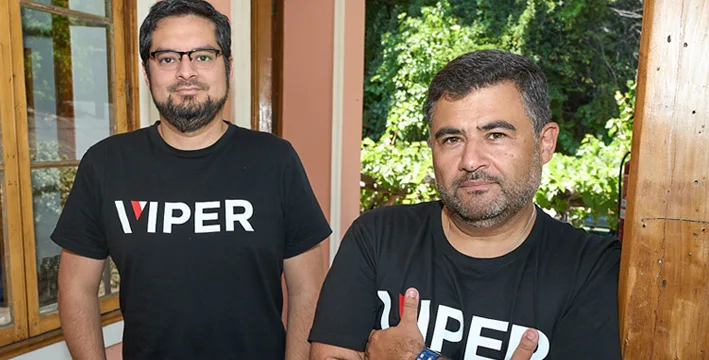
- - Camilo Salazar de la Fuente is an industrial engineer from the Pontificia Universidad Católica de Chile, with a Master of Science from the same university and an MBA. He has 20 years of experience in process management in the retail and healthcare industries, at companies such as ACHS and Walmart, and holds a diploma in Disaster Risk Reduction Management. Former volunteer firefighter.
- - Exequiel Gallardo Pilar is an aeronautical engineer from Universidad Técnica Federico Santa María, with more than 15 years working at software development and integration companies. Volunteer firefighter and member of the Chilean USAR international response team.